GDPR vs ESG: Why Your SME Needs Both
If you run a small or midsize business in the European Union, you are already familiar with GDPR. You probably have a privacy policy, a cookie banner, and someone on the team who handles data subject requests.
ESG is newer territory. The Corporate Sustainability Reporting Directive is expanding sustainability reporting requirements to tens of thousands of organisations. If your company has more than 250 employees, the clock is already ticking. If you have between 10 and 250 employees, you are next.
Most companies treat these as entirely separate workstreams. One team handles data protection, another handles sustainability. Different spreadsheets, different processes, different deadlines.
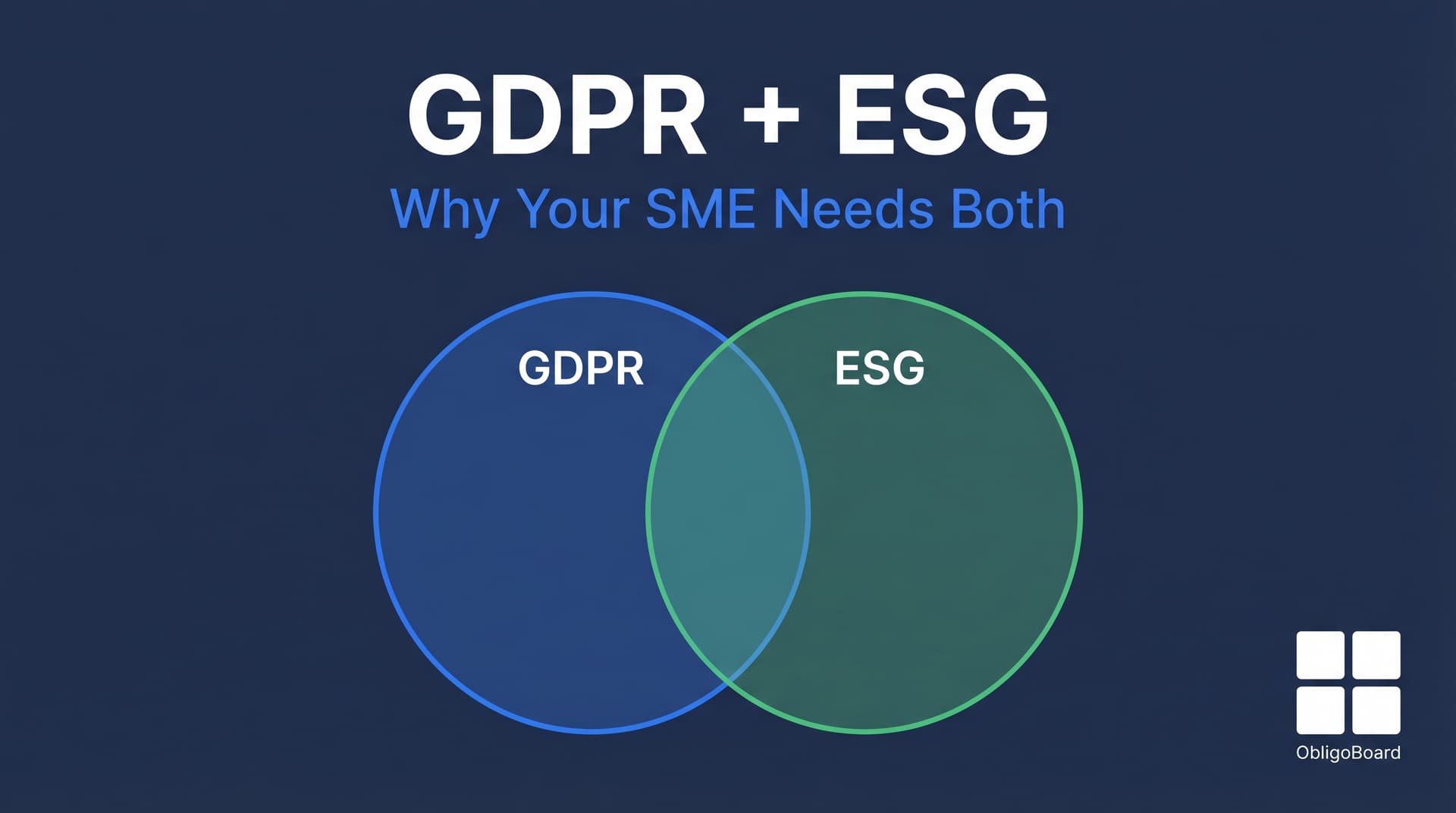
But when you look at what both actually require, the overlap is striking.
What GDPR and ESG Have in Common
At their core, both GDPR and ESG compliance are about the same thing: proving that your organisation follows a set of rules, and that you can demonstrate it when asked.
Both require:
- Documented processes — You need written policies and procedures that describe how you handle personal data (GDPR) and how you address environmental, social, and governance factors (ESG)
- Evidence trails — It is not enough to say you are compliant. You need to show the documentation, training records, assessments, and reports that prove it
- Recurring obligations — Both frameworks include tasks that repeat: annual reviews, quarterly assessments, monthly reporting
- Assigned ownership — Someone needs to be responsible for each obligation. Unowned tasks do not get done
- Audit readiness — Regulators, auditors, and increasingly clients and investors expect structured reporting on demand
Where They Differ
The differences are in scope and subject matter, not in the mechanics of compliance:
- GDPR focuses on personal data: how you collect it, store it, process it, and protect it. The obligations come from a single regulation with clear articles and guidance
- ESG covers a broader set of topics: carbon emissions, labour practices, governance structures, supply chain responsibility. The standards are still evolving, with CSRD and ESRS providing the framework for EU reporting
But the workflow is the same. Track what you need to do. Assign someone to do it. Collect the evidence. Report on it.
Why Tracking Them Together Makes Sense
If you already have a system for tracking GDPR obligations, adding ESG to the same system is simpler than building a second parallel process.
Here is what you gain:
One dashboard instead of two
Your compliance lead can see both GDPR and ESG status in a single view. No switching between spreadsheets or tools. No risk of one framework being neglected because it lives in a different system.
Shared evidence infrastructure
Many organisations already collect documents that serve both purposes. Employee training records are relevant to GDPR (data protection training) and ESG (social responsibility). Vendor assessments matter for GDPR (data processing agreements) and ESG (supply chain governance). When evidence is stored in one place, it can be referenced by obligations across both frameworks.
Consistent reporting
Auditors and clients increasingly ask about both data protection and sustainability in the same conversation. Having a single reporting system that covers both means you can generate one evidence pack rather than assembling information from multiple sources.
Simpler team onboarding
Teaching your team one compliance workflow is easier than teaching them two. If they already know how to track GDPR obligations, adding ESG obligations to the same board requires almost no additional training.
The CSRD Timeline
The Corporate Sustainability Reporting Directive is phasing in across the EU:
- 2025: Large public-interest companies with 500+ employees
- 2026: Companies with 250+ employees, or meeting two of three criteria (EUR 50M turnover, EUR 25M assets, 250 employees)
- 2027-2028: SMEs listed on regulated markets, with simplified VSME standards
Even if your company is not yet required to report under CSRD, enterprise clients are increasingly asking their suppliers to demonstrate ESG practices. Being ahead of the requirement is a competitive advantage, not just a compliance exercise.
Getting Started
If your organisation already tracks GDPR obligations, extending to ESG does not require a new tool or a new process. It requires adding a second framework to your existing compliance workflow.
ObligoBoard supports both GDPR and ESG frameworks in a single dashboard. Each framework comes with pre-built obligations, plain-language guidance, and evidence collection — the same structured approach, regardless of the regulation.
Start your free 14-day trial and add your first ESG framework alongside GDPR. Setup takes less than fifteen minutes.
Pronto a rendere il tuo registro difendibile?
Monitora gli obblighi che ti riguardano con le evidenze allegate, ed esporta un report pronto per l'audit ogni volta che ti serve.
Inizia la prova gratuitaArticoli correlati
Why Spreadsheets Are a GDPR Compliance Risk
Spreadsheets feel familiar, but they create real compliance gaps. Here is why they fall short for GDPR tracking and what to use instead.
GDPR Compliance Checklist for SMEs (2026)
A practical checklist covering the key GDPR obligations every SME needs to address in 2026.